Category: The Killing of Neda
Neda, the girl who died so the world knew
Three years ago, on 20 June 2009, Neda, the Iranian girl, bled to death on the streets of Tehran, shot by an Iranian pro-government militiaman during the protests to the fraudulent presidential elections.
She was one of hundreds of people who were slain by the Iranian brutal government, just because she aspired for change. Right before she died, her gaze was captured on a cameraphone, circulated the web, and caught the attention of millions around the world and became the most watched death in the history.
In the days after she died, the international media went hysterical about this tragedy. Presidents and Prime Ministers condemned it, the Iranian people called for justice, the Iranian government denied it. But her death had moved millions. The world now knew. They knew that in the mysterious land of Iran, there also lives a generation who is so much like their peers around the world, a generation who wants to find joy in life, wants to have a voice, and is ready to give up everything in the quest for freedom.
However, three years have passed now. The green movement has been suppressed violently, hundreds of people are in prison, hundreds in anonymous graves, and those who have a grave are under constant surveillance lest people pay homage to them.
Three years have passed and the world has moved on. Their only concern about Iran is for the nuclear ambitions, for which no evidence exists. In the meantime, those who shouted for freedom have fallen into despair, feeling that the world has forgotten them. In the meantime, the world no longer remembers Neda, the girl who stared into the camera seconds before she died, saying ‘look at me, don’t forget that they killed me, because I wanted to have a voice.’
The media has moved on, they no longer care about the most watched death in the world, it’s the time of Euro games, and then Olympics.
And the brutal Iranian regime looks back at all the crimes and injustice it committed in the last three years, and realised that no one really cares anymore. The fundamental regime smiles and says, ‘I did the right thing to kill all those who protested. I’ll do the same next time. After all, everyone would forget the bloodshed before the next Olympic games
Arash Hejazi’s Interview with BBC World – Outlook – Thu, 22 Dec 11
The doctor who got death threats after trying to save the life of Neda Agha-Soltan, the young woman who became the symbol of the anti-government protests in Iran in 2009.
Arash Hejazi’s interview with Radio Netherland about his memoir The Gaze of the Gazelle
As British embassy officials flee Iran, we speak to an Iranian man in the UK: Arash Hejazi.
He’s the doctor who tried to rescue Neda Agha-Soltan, the young woman who was shot during the 2009 protests in Tehran and became an icon of the struggle for democracy there. YouTube: Death of Neda (warning: graphic content)
Arash talks to host Jonathan Groubert about living through four decades of tumult in Iran before finally hitting his breaking point.
The Gaze of the Gazelle is Arash Hejazi’s memoir of growing up and then fleeing Iran.
Listen to the interview here:
Book Review: The Gaze of the Gazelle, the memoir of a little boy who became a revolutionary for truth
Source: Middle East Book Review
We talk about the tyranny of the Shah of Iran and the even worse tyranny of the Mullah’s that followed. We talk about the politics of Iran today and its role in terrorism, violence and the instability of the Middle East. We talk about the conflict that the United States started using their dictator pal Saddam Hussein, and quickly forget the hardships that were wrought on the people of Iran and also Iraq. And we talk about the Middle East conflict as if it is just another story.
Yet what we don’t talk about are the lives that were destroyed and permanently altered, reshaped violently and the many deaths, most of the dead are names and faces we will never know or see.
Iran has been but a political square in a political debate. But it is a nation of enslaved people, enslaved under the pro-Western backed tyrant the Shah Reza Pahlavi and then by the Ayatollah Khomeini and then again by the little dictator President Ahmedinejad.
Arash Hejazi tells the story to the Western World that is so ignorant of the facts of the Middle East and the Persian Gulf and the Islamic World in a way that puts a human face on its cover. “The Gaze of the Gazelle” is a poignant retelling of all the history we have accepted as political rhetoric in a human form. The story of real people who were impacted by our policies and our political viciousness and our stereotyped rhetoric and racism in America.
The story begins from the eyes of a young boy and watches as the world around him collapses following the fall of the Shah and the Rise of the Mullah tyrants. Then there is the war with the US backed Iraq and Saddam Hussein and the destruction in brought on everyone in the country. He tells the story of how he watched the Revolution turn from a people’s movement to another vicious dictatorship, this time religious and twisted. And he recounts the day when he was only 17 and watched the Mullah’s soldiers pull aside a young Muslim woman who was also only 17 and shoot her in the head in front of a crowd of frightened observers.
He watched as his family life was destroyed and his friends and his father’s friends fled or vanished.
No one could speak but Arash managed to launch a publishing company and his struggle to get the true story out about the criminal behaviour of the leaders of Iran is a compelling story that every American should read. It was our tax dollars that paid for the bullets that fired into the brains of young women by the mullahs, that bought the scimitars that were used to cut off the heads of dissidents, and that funded the bombs that rained down on millions of innocent people.
We owe it to the Iranian people to at least try to learn the truth.
“The Gaze of the Gazelle” offers one window into the horrors of the history of Iran under tyrannical oppression over the years.
I couldn’t put this book down. It read swiftly and cleanly and with a comprehension that was utterly shocking to me. I urge everyone to read this memoir of a little boy who became a revolutionary for truth.
Read the full review here
The National’s Review on The Gaze of the Gazelle: Witness to a death that changed history

Source: Noori Passela, The National, Sep 16, 2011
Arash Hejazi is an Iranian writer, publisher, doctor and one of the few to witness Neda Agha-Soltan’s dying moments first-hand, when he captured it on a mobile-phone camera during the 2009 riots. It was his choice to upload the video, whichsparked an international media frenzy over the death of the bright-eyed young woman.
Forced to leave his country and live in exile due to his prominent role as an opponent of the Ahmedinejad regime, it is no surprise that Hejazi comes across as a weary narrator.
Along with Hejazi’s recollections of his youth and experiences in Iran’s publishing industry, The Gaze of the Gazelle is also an account of the nation’s history of uprisings – political, religious and cultural. From being prosecuted by hardline Islamists for his outspoken attitude at college to the difficulties he endures under Iran’s strict censorship regulations, Hejazi spares little in recounting the decline that finally culminated in the incident that put him in the global spotlight.
Hard-hitting and direct, this book provides valuable revelations about a struggle that receivedvery little coverage inside Iran.
A review on The Gaze of the Gazelle: Witness to a death that changed history
Source: Noori Passela, The National, Sep 16, 2011
Arash Hejazi is an Iranian writer, publisher, doctor and one of the few to witness Neda Agha-Soltan’s dying moments first-hand, when he captured it on a mobile-phone camera during the 2009 riots. It was his choice to upload the video, whichsparked an international media frenzy over the death of the bright-eyed young woman.
Forced to leave his country and live in exile due to his prominent role as an opponent of the Ahmedinejad regime, it is no surprise that Hejazi comes across as a weary narrator.
Along with Hejazi’s recollections of his youth and experiences in Iran’s publishing industry, The Gaze of the Gazelle is also an account of the nation’s history of uprisings – political, religious and cultural. From being prosecuted by hardline Islamists for his outspoken attitude at college to the difficulties he endures under Iran’s strict censorship regulations, Hejazi spares little in recounting the decline that finally culminated in the incident that put him in the global spotlight.
Hard-hitting and direct, this book provides valuable revelations about a struggle that receivedvery little coverage inside Iran.
The killing of Neda Agha Soltan & an extract from The Gaze of the Gazelle
Arash Hejazi John Angerson
Arash Hejazi witnessed the shooting of Iranian student Soltan in Tehran in 2009. What he did next would rock the regime – and change his life for ever
The house is part of a bland new estate on the western edge of Oxford. In its sparsely furnished living room, the floor littered with toys, a young boy is playing computer games. His mother is making coffee, but his father, though physically present, is mentally a thousand miles away from this mundane scene. He is on his laptop, watching camera-phone footage of an event that has changed his life for ever, and may eventually be seen as the beginning of the end of one of the world’s most pernicious regimes.
The jerky, 47-second clip shows an attractive young woman wearing jeans and sneakers beneath a long black coat. She is outside on a street, and being lowered gently to the ground by two men. One has grey hair tied back in a ponytail. The other is younger and wears a white shirt and jeans.
As she lies on her back, the woman’s brown eyes swivel sideways towards the camera. “Don’t be afraid, Neda. Don’t be afraid,” the older man implores her. Suddenly a stream of dark red blood spurts from her mouth and runs down the side of her face. Then a second stream of blood gushes from her nose, drowning an eye.
There is panic in the voices of those around her. “Stay, Neda. Stay with me!” the first man cries. “Open her mouth. Open her airways,” yells the man in the white shirt as he presses on a wound in her chest in a desperate attempt to save her. Seconds later it is all over. The woman is dead. An onlooker holds out his hands, palms open, in apparent despair and bewilderment.
The woman was, of course, Neda Agha Soltan, the 27-year-old Iranian student shot dead during one of the massive street protests that rocked Tehran following President Mahmoud Ahmadinejad’s blatantly rigged re-election in June 2009. The man with the ponytail was her music teacher, and the man in the white shirt is Arash Hejazi, 40, a doctor-turned-publisher who is now sitting in his rented house in Oxford watching the video clip.
This thoughtful, softly spoken Iranian has watched the footage 100 times before, and with good reason. He could so easily have left the scene, washed Soltan’s blood from his hands and kept silent. Instead he took a stand. He resolved to let the world know what the regime had done to Soltan, how evil had destroyed innocence. In a forthcoming book, The Gaze of the Gazelle, he reveals how he himself posted the video on the internet within an hour of her death. He recounts how, as the regime did its best to discredit the footage that had ricocheted around the planet and made Soltan a symbol of its barbarity, he fled to Britain and told the world how she had been shot by a government militiaman.
For Neda: The film: Tuesday 21 June, 10.00 PM on More 4 (UK only)
On 20 June 2009, Neda Agha Soltan was shot in the heart by a sniper and lay bleeding to death in a backstreet of Tehran. Within hours of her death this young Iranian woman’s dying moments, captured on mobile phones, were appearing on computer screens across the world.
Anthony Thomas’s film tells Neda’s personal story and attempts to find out who this young woman was, how she became a powerful symbol to millions and what she was fighting for.
The film not only shows the plight of the Iranian citizens who peacefully fought to free their country from its current government regime, but also the ongoing struggle the women of Iran face every day in an attempt to live a life free from oppression.
The only way to get to the heart of the story was to work inside Iran, at a time when foreign film-makers are forbidden entry, and Iranians themselves risk arrest and long-term imprisonment if caught filming without official approval.
The film won the Foreign Press Association’s Best TV Feature/ Documentary Award and was among 2011′s Peabody Awards winners list.
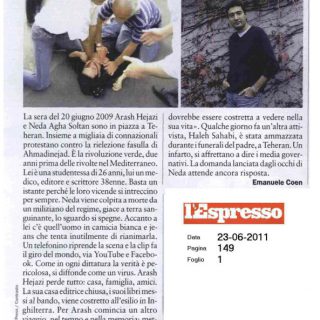
Arash Hejazi’s Interview with the Italian Magazine Io Dona: I can’t live in silence, Neda’s eyes hunt me
“Non posso vivere nel silenzio, gli occhi di Neda mi perseguitano”
Dal suo rifugio a Londra parla ilmedico che cercò di salvare la studentessa-simbolo della rivolta iraniana. E che trovò il coraggio graziea Paolo Coelho
di Emanuela Zuccalà, Io Dona, 20 May 2011
UNA RAGAZZA A TERRA, il volto percorso da rivoli di sangue scuro. Due uomini tentanodi rianimarla. Uno urla: “Resta con me!”. Le grida della folla crescono tragiche e confuse. Era il 20 giugno 2009: a Teheran milioni di persone manifestavano contro i brogli elettorali, che avevano portato alla vittoria del presidente Mahmud Ahmadinejad sull’avversario riformista Mir-Hossein Mousavi. Neda Soltani, 26 anni, studentessa di Filosofia freddata da un miliziano, diventava il simbolo dei giovani iraniani affamati di libertà. La sua morte in diretta, ripresa da un telefonino, si diffondeva per il globo attraverso YouTube: un documento eccezionale, che rivelava senza filtri la brutalità del regime iraniano. A metterlo online era stato lo stesso uomo in camicia bianca che nel video cerca di salvare Neda. E che adesso siede di fronte a me in un appartamento di Londra.
The Gaze of the Gazelle, a story of a generation: Arash Hejazi’s Memoir
Well, there is something to write about after all. My memoirs The Gaze of the Gazelle, is coming out in spring 2011 by Seagull Books in English.
Writing this memoir in the past twelve months has been the only help I have had to survive the memory of the horrors I experienced last year, in June 2009, when Neda, the young and brave Iranian woman, bled out under my hands, in a street in Tehran. She looked into my eyes before she turned towards the camera, trying to say something.
She never managed to say it. But I am trying to answer that question in those gazelle eyes: How did it come to this?
My close friend Paulo Coelho, the renowned author of The Alchemist and The Zahir, was the first one to identify me as “the doctor” in the footage taken from Neda’s sad death. And now, he has kindly written a foreword to the book, which I will publish shortly here and in the other media.
I hope you will support me by spreading the word about this book. I will write more about the book soon.
With love,
Arash Hejazi
O World! Enough hesitation! It’s time to act

[Read the text in Persian Here]
[Read the text in French Here]
Hundreds of newspapers have been shut down in Iran; international reporters have been banned; hundreds of Iranian journalists are in prison; internet has almost been shut down; the sophisticated filtering system has blocked the contact of the Iranian people with the world; the police is massacring people in the streets in broad daylight and then blames the violence on the people themselves; the government is giving out lies after lies; all the minority ethnic and religious groups are suffering from the official oppression; prisoners have been tortured, raped, murdered; the Basij militia shoots unarmed civilians in the streets; students have been expelled from the universities because of protesting against tyranny…
While you, people of the world, are celebrating the New Year by embracing your loved ones with joy, while you dance to the Christmas tunes, the young people in Iran are dancing to the macabre music of the bullets and embrace batons and teargas. While you are hugging each other and wishing a happy new year, mothers in Iran are forbidden to shed tears for their children who were brutally murdered by the police trucks running them over. The people of Iran are alone, they are broken, they are tired, but determined to go on.
Do you think this has nothing to do with you? Do you think that you only need to worry about your domestic affairs? Do you think that saying a few words of condemnation will redeem you from your global responsibility towards human rights? Is this the global citizenship you preach?
This is the most dangerous State in the world. Hesitate in acting and you will see how this government, rooted in lies, will destroy your own children. What do you expect? Do you think that a totalitarian regime that does not show mercy to its own children will have pity on your people? Do you think that this beast will stay calm and watch you? Wrong! Hesitate and see.
The people of Iran have spoken with their torn throat and through the last sparkle of life in Neda’s eyes; they have written their vows with their own blood on the pavements in the streets: They want to be global citizens, they resent terrorism, tyranny, lies, wars, nuclear weapons… and they have died the most brutal deaths for speaking out. Why are you watching silently? Do you think you are safe? Do you think that this cancer will be contained inside the borders or Iran? Do you think that the rotten claw of this grim reaper will not reach you? Wrong. Hesitate and see.
It is time to act. There are people drowning in Iran. Do not believe the lies of the Iranian government. This government that denies all these brutalities is the same that denies the Holocaust, that claims that there are no homosexuals in Iran, that Neda Agha Soltan was killed by CIA, MI6 and BBC, and there is freedom of press in Iran.
How to act? We do not want any violence. This government is falling. Just do not support the government. Do not recognise the current government of Iran. Do not negotiate with them – How can any negotiation with someone who tells nothing but lies and is willing to break any promise, be fruitful? Do not be deceived by their lies. Expel the Iranian ambassadors and diplomats. You will lose nothing and will gain everything by supporting the future of Iran. Hesitate, and you will be run over by the evil machines of this rotten government. Hesitate, and you will be weeping over the graves of your own children.
It is time to act. Hesitate, and when you regret your hesitation, it will be too late.
Arash Hejazi, 30 December 2009
The open letter of Neda to President Obama
The letter bellow was posted on my facebook discussion page yesterday by the ID Mehdi Amin, which I’m sure is an alias. The letter is based on my open letter to President Obama; but this time it’s not me who is addressing the President; it’s Neda Agha Soltan. It was a really moving letter and therefore I have posted here (courtesy of Mehdi Amin), so that perhaps President Obama reads it:
Dear Mr. President Obama,
My name is Neda Agha Soltan. I was killed by a Basiji in a street of Tehran while watching a post-election protest. Perhaps you remember me. Millions of people watched me die in less than 40 seconds. Perhaps you remember my open eyes when I took my last breath. But I will live for ever in the memory of freedom loving people of the world. I have become the guardian angle of my sisters and brothers who are fighting for a free Iran; I have become their voice and that is why I am writing to you.
Just imagine one of your daughters dying in the same way as I did! How would you feel if not only the killer went unpunished, but got rewarded for what they did? What would you tell millions of Iranian young people who are feeling that the beacon of freedom has betrayed them by shaking hands with the killers of their sisters and brothers? What would you tell your daughters if they asked why you are rewarding the killers of Neda?
I am the voice of the people of Iran . I am calling upon you to support the democratic movement of people in Iran . I am not asking you to make war. I am not even asking you to help our struggle for freedom. I am just asking you not to support the government that has terrorized its own nation for 30 years. I am just asking you to stand on the side of humanity instead of oppression, torture, rape, and killing.
With regards
Neda Agha-Soltan
I don’t know who David Fairbanks is, but his kind words brought tears into my eyes. No dark force can beat this dignity
Arash Hejazi’s Interview with The Times / November 13, 2009
Iranian doctor Arash Hejazi who tried to rescue Neda Soltan tells of wounds that never heal
As Arash Hejazi sat in an Oxford coffee bar, members of Iran’s Basij militia in Tehran were demanding his extradition outside the British Embassy.
The previous day the Iranian regime had sent an Oxford college a letter of protest over a scholarship given to honour Neda Soltan, the student killed during a huge demonstration against electoral fraud in Tehran in June. The letter also suggested that Dr Hejazi was responsible for her murder.
Ahmadinejad versus Oxford University and Neda
The Iranian Embassy Objects to the Queens College’s Neda Scholarship
The Queen’s College venerates the memory of Neda Agha Soltan; the Iranian Government blames it on Arash Hejazi!
The paradox lies in the fact that the Iranian government has reacted in different manners towards the death of Neda. First, the head of the Iranian National TV claimed that the video of her death was fake. But then, when they no longer could deny the death of Neda, they blamed the BBC correspondent in Iranfor her death.However, the Ambassador of Iran in Mexico claimed in an interview that her murder was planned by CIA. The protesters to the election results in Iran and the People’s Mujahedin Organisation where other bodies blamed by different Iranian authorities.Then, after Arash Hejazi, the doctor who tried to save Neda in her last moment, explained in an interview with BBC that the Iranian militia or Basij were responsible for her death, he himself was ironically held responsible for Neda’s death and a prosecution started to arrest him. The Iranian Police Chief declared officially that Interpol is looking for Arash Hejazi, an allegation that was refuted instantly by Interpol.More than a week ago, the chief of the Martyr’s foundation of Iran said that Neda could be considered a Martyr if the police and the judiciary approved that she was killed by the Iranian opposition or foreign intelligence services, although the mother of Neda announced that if she was a martyr, she was a martyr for her people, not the Islamic Republic.
Neda versus Ahmadinejad
Now, in an ironical turn of events, when Oxford University decides to venerate the memory of Neda, Ahmadimejad’s government protests against this decision, claiming that it is a ‘political move’ and she is just someone ‘murdered’.
The Involvement of Arash Hejazi
Arash Hejazi’s involvement in the case of Neda is where he was present at the time of her death accidentally. He rushed towards her in an attempt trying to save her. In vain, Neda’s body was drained out of blood in less than a minute. Then, when he believed that the truth was being distorted, he left Iran and in an interview he described the circumstances of her death. Since then, the government of Iran has always been vengeful against him.
However, in the letter of the Embassy of Iran to the Queen’s College, it is claimed that Arash Hejazi who was involved in Neda’s murder, is ‘a fellow’ to the Oxford University. This couldn’t be farther from truth and there will be no surprise if Oxford University discredit’s this claim instantly.
Arash Hejazi has never studied in the University of Oxford and has no relationships to them. He has studied in Oxford Brookes University, an academic body completely separate from the University of Oxford.
The Involvement of the Iranian Government in Neda’s Death
It seems that the Iranian government, trying to conceal its own involvement in the brutal murders that happened after the Presidential elections of Iran, is rushing towards discrediting itself.
No one can deny that on the same day that Neda Agha Soltan died, at least 30 other protesters were shot to death by the Iranian militia. They were shot in the the eye, the chest and the neck, proving that the shooters were aiming to kill, rather than aiming to control.
Neda Agha Soltan murder witness at risk of torture in Tehran prison
Caspian Makan, the fiancé of Neda Agha Soltan, a young woman killed in the recent protests in Iran, has been held in detention since 26 June, after he made a statement linking her murder to the pro-government Basij militia.
Currently held in Evin Prison in Tehran, Caspian Makan is reported to have told his family that if he signs a “confession” saying that the People’s Mojahedeen Organization of Iran (PMOI), a political body banned in Iran since 1981, killed her, then he may be released.
Amnesty International said it fears he may be forced to sign such a “confession” under torture or other ill-treatment, given the pattern of human rights violations in Iran following the election. The organization said that he may be a prisoner of conscience, held for peacefully exercising his right to freedom of expression.
(read the rest)
The problem is that he cannot confess to anything, as he was not present when Neda got shot!
The face of Abbas Kargar Javid — man accused of killing Neda Soltan
The Times
August 20, 2009
The man accused of killing Neda Soltan has been identified as Abbas Kargar Javid, a pro-government militiaman, after photographs of the Basiji’s ID cards appeared on the internet.
The identification challenges the Iranian regime’s claim that foreign agents shot the young woman, who became a global symbol of resistance to the Government of President Ahmadinejad.
Neda Agha Soltan’s alleged shooter: Saturday, 1 August 2009
Images of three cards that have been attributed to the shooter of Neda Agha Soltan were published on the internet. I am here confirming that the photo of the individual that appears on this card completely matches the particulars that I recall of the individual who was seized by people a few minutes after Neda was shot, and who was shouting “I didn’t mean to kill her.” However, on that day, his beard had been shaved off, but he had his mustache. But in order to be 100% certain, since sometimes an innocent person is wrongly accused, we should consider another form of proof about this individual.
Because after people seized the shooter, they took his shirt off his body, and on the shooter’s back, I saw some old scars. These scars resembled the traces of wounds produced by a cutting instrument or something sharp.
Please note: I have only identified the owner of the photos. I can’t confirm his personal details. Furthermore, don’t discount the possibility of human error.
I hope that this information can help in bringing this case to justice, and likewise I call on my fellow-citizens to avoid all violence. This information is valuable insofar as it assists in the arrest of this individual. As for the rest, let the law take its course. This individual has the right to be fortunate enough to select an attorney and to defend himself. When people take the law into their own hands, they can cause unintended harm [literally “burn both the good and the bad together.”]
Again, I emphasize: do not allow anger to stain your honor in any way.
With hope for better days,
Arash Hejazi
A note for future generations: 02/07/2009
My fear, however,
is of dying in a land
where the wage of the grave-digger
is higher than the price of human freedom.
Ahmad Shamlu, Iranian contemporary poet
After my June 25th interview on BBC regarding my personal observations on Neda Agha Soltan’s brutal murder, I read in the press on July 1st that a warrant had been issued by Iranian government for me to be arrested.
As I mentioned in my interview with BBC, such a desperate move towards concealing the truth regarding this cruel crime was to be expected from an administration that is built on lies and injustice. I predicted in the aforementioned the interview that they were going to denounce what I said; that they were going to put so many things on me. This administration, instead of trying to find the real murderers of this innocent girl and several other victims and accept responsibility for its inefficiency, is trying to blame every other single soul, country or body that has done nothing wrong.
Pressure is being put on my friends and family in Iran who had nothing to do with this incident. My 70 year old father who is a university professor and a distinguished member of the academic society has been questioned without even knowing what he had to do with any of this.
I just did what every decent human being would have done at the same situation. I tried to save a victim, and when the truth about the circumstances of her death was being distorted by the Iranian State media, I testified for what I had witnessed.
I have lived my life in such a way that does not leave regrets for me. As a trained physician, I was one of the first doctors that travelled to Bam after that terrible earthquake, just to be there for those innocent victims who were on the verge of losing their hopes.
This time, I was there for another innocent victim, by mere accident, without having a clue on what I was going into. But this time, this victim was not killed by a natural disaster. It was greed and lust for power that shed her blood.
I am also a writer, and if you read my novels, my articles and my speeches, you will realise that I have always advocated human rights and have always paid a price for it.
I have always tried to live a truthful and honest life and have never betrayed my values.
I believe what I did in trying to save Neda and tell her story was the right thing to do. I believe, as my dear friend Paulo Coelho says, that god is the lord of the valiant. I believe that the truth shall set us free. I did everything according to my conscience and if I have to pay a price for it, so be it. But I have the right to defend my honour and dignity.
I swear by god who is my witness and I swear by my honour, that I told the truth and nothing but the truth about what I saw.
The Islamic Revolution and the Islamic Republic of Iran were founded on what Iranian people still stand for today. People relied on these beliefs when they fought against tyranny and then when they sacrificed so much blood to defend their country against the invasion of another tyrant, ruling Iraq with iron fist.
However, this lie undermines every other statement of this specific administration of Iran; this administration that has distorted the history of WWII, claims that freedom of press and speech is openly practised in Iran, claims that Iranian prisons hold no political prisoners, claims that there are no censorship practised on books, information, media and the press of Iran, and pretends that it respects civil rights such as freedom of assembly, freedom to protest and equal rights for Iranian citizens, regardless of their gender, race and religion.
In the past twenty days, the world has witnessed through the tearful eyes of the brave Iranians that all these claims have been nothing but lies. I am sure the world will not believe this new lie and will understand that a doctor, writer and publisher has done nothing but what his conscience has dictated, in rushing to help those who needed help, and telling the truth.
Neda was not the only person slain in Iran during this turmoil. Have all those people, innocently murdered, been victims of an international conspiracy? Why aren’t the murderers of the other victims being prosecuted? Or perhaps one should blame the recklessness and inefficiency of the uncontrolled armed militia who failed to wisely handle the legitimate protests of Iranian citizens towards injustice.
I am just a witness. Why prosecute a witness instead of prosecuting the murderer? Have not enough blood been already shed? Should I have remained silent against this gruesome crime, out of fear? Is this the message we are preaching for our next generations?
I believe that no decent global citizen will ever fail to support me and thousands of other Iranians who were beaten, imprisoned, prosecuted and slaughtered, only because they wanted to be a free nation and join the world in the path towards prosperity and justice and share their rich culture and their history of bravery.
I am proud to be part of this. I have done what every decent person would have done, and for that I am being threatened; just as all these martyrs did what every free soul would have done, and for that they were murdered; murdered by a dark hatred towards anything they stood for: freedom, truth, and justice.
Arash Hejazi
July 2nd 2009